

Key Takeaways
- Pharma R&D costs have exploded over the past few decades. Agents have the potential to reverse this trend, but general AI tools lack the domain knowledge and data integrations life science actually needs.
- We built Deep Life Sci, an open source agentic assistant for clinical and lab scientists. It pulls directly from tens of millions of scientific articles, performs data analyses in a secure sandbox, and delegates tasks to hundreds of sub-agents.
- Deep Life Sci makes owning your intelligence simple. R&D teams can add their own data and context, and then use LangSmith tracing and evals to see what's actually working.
Eroom’s law (hint: read Eroom backwards) is Moore’s law’s evil twin. The exponential drop in the price of computing power over the past 70 years has given us personal computers, the internet, cell phones, and now the AI revolution. Pharmaceutical research, unfortunately, has gone in the opposite direction, with the cost of developing each new drug doubling every nine years.
AI agents have the potential to reverse this trend, but general purpose solutions aren't built with the domain specificity that life science organizations need. That's why we developed Deep Life Sci: an open source agentic assistant created specifically for clinical and lab scientists.
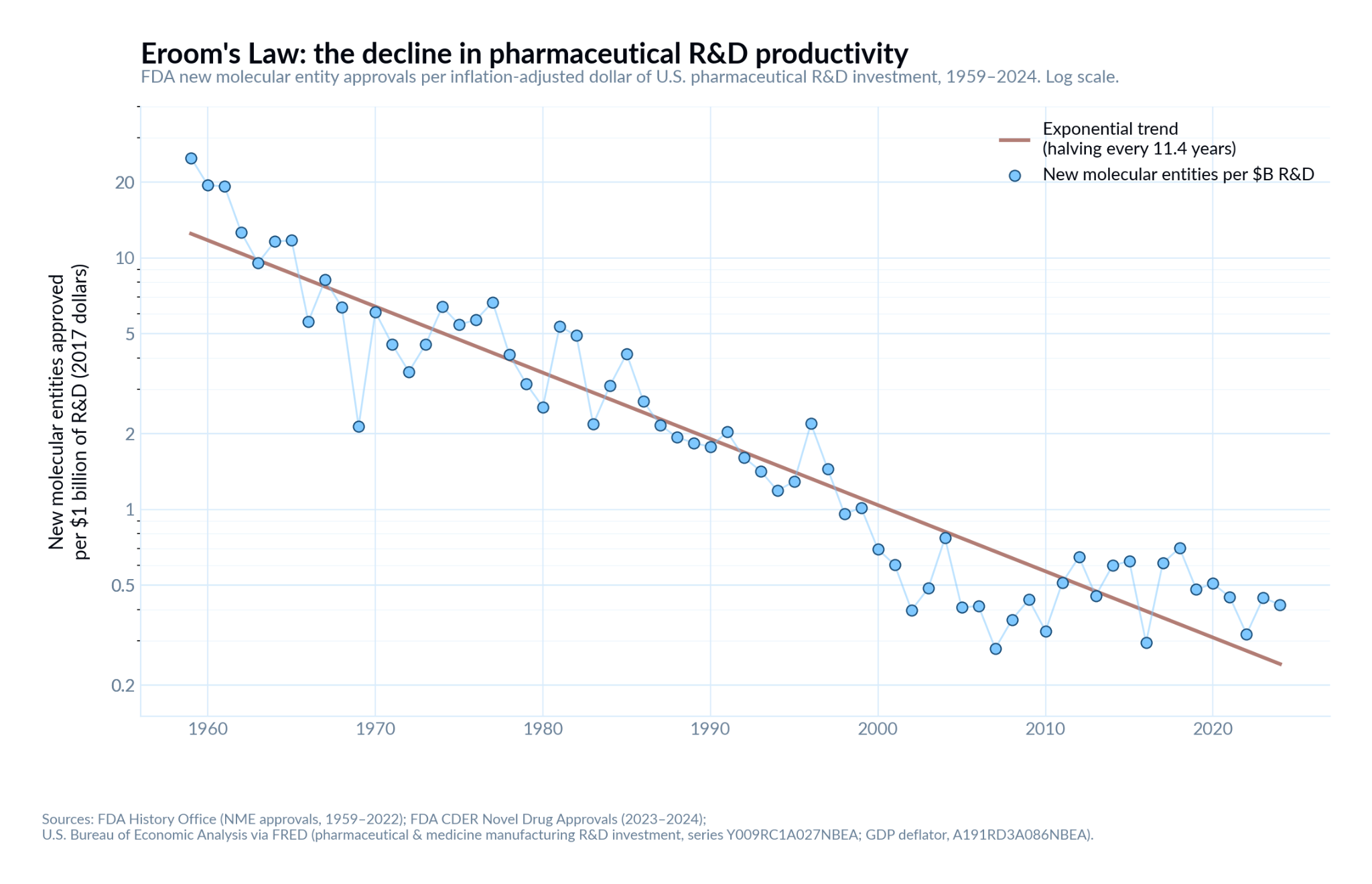
The accelerating cost of pharmaceutical research and development
The runaway cost growth in pharma comes from both stages of the drug development process: preclinical research and clinical trials. Identifying promising drug targets involves sifting through millions of scientific papers and massive biological datasets for insights. Once a candidate molecule appears likely to be safe and effective, it graduates to human clinical trials, where tens of thousands of pages of paperwork must be done to ensure compliance with a growing body of FDA regulations.
Many AI companies have promised that their tools will help restore research productivity, but general-purpose AI assistants like Claude and ChatGPT lack the necessary domain knowledge and integrations with scientific data sources. More specialized AI products for biotech often charge large markups.
In both cases, the agent harnesses are proprietary, preventing users from customizing them and locking them into expensive closed-source models. This issue is particularly critical in life sciences, where GxP validations require thorough documentation and audit logs that can articulate why the system behaves the way it did, requiring companies to have complete control of whatever system is being used to drive clinical decision making.
An open source agentic assistant for life sciences
At LangChain, we believe that organizations that own their own intelligence will hold the advantage. We developed Deep Life Sci, an open source agentic assistant for clinical and lab scientists built on our Deep Agents harness, as a template for companies to adopt and modify for their use-cases.
Deep Life Sci can access clinical trial records from over 600,000 registered studies on ClinicalTrials.gov, 29 million paper abstracts through PubMed, and 12 million full-text articles on PubMed Central, reviewing hundreds of documents at once by assigning them to sub-agents. Each agent comes with a LangSmith sandbox, allowing it to safely run code to perform arbitrary data analyses. Users can upload PDFs, images, tabular data files, bibliographic files such as RIS, sequence ones such as SMILES, FASTA, and more, for the agent to include in its work.
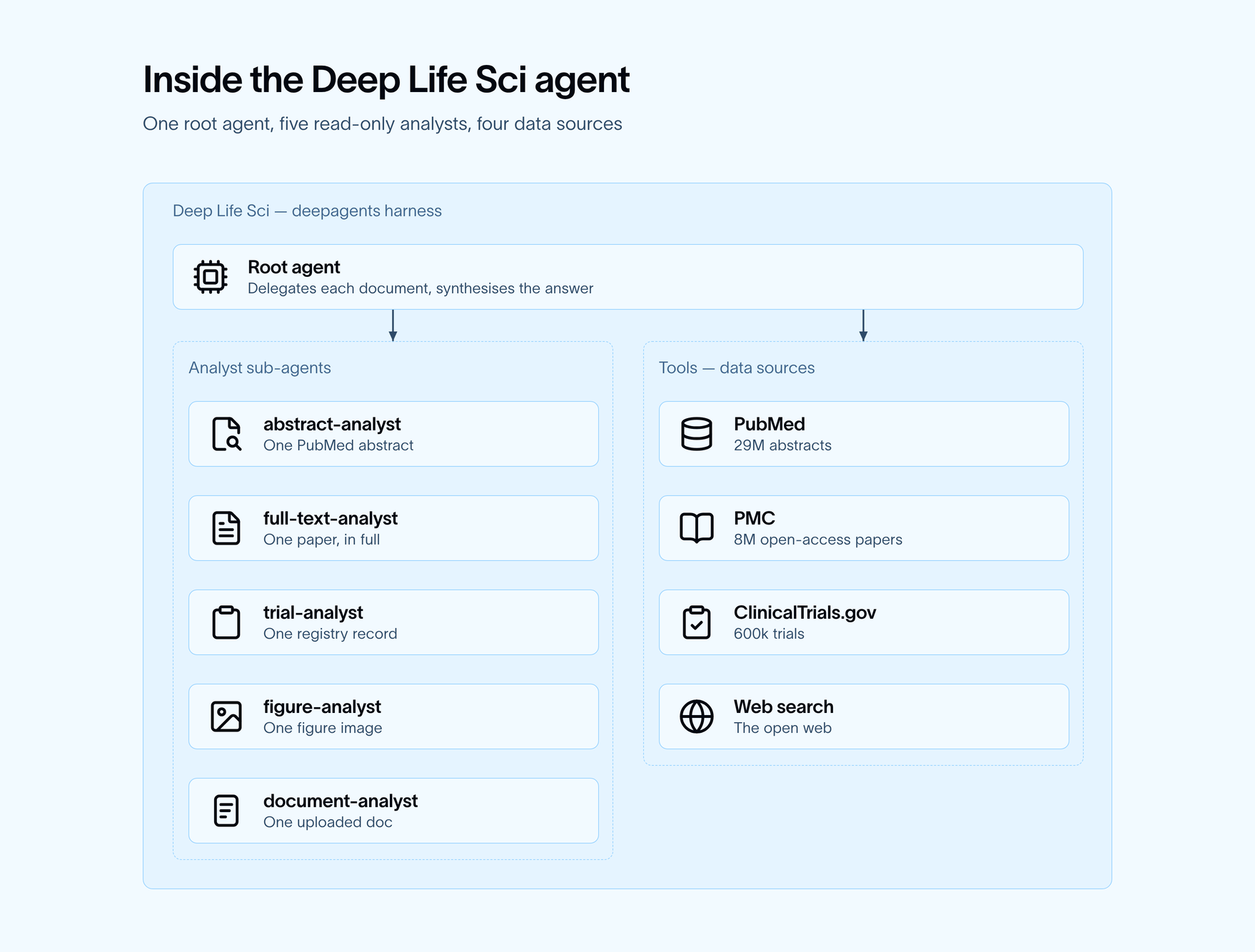
Example agentic workflows with Deep Life Sci
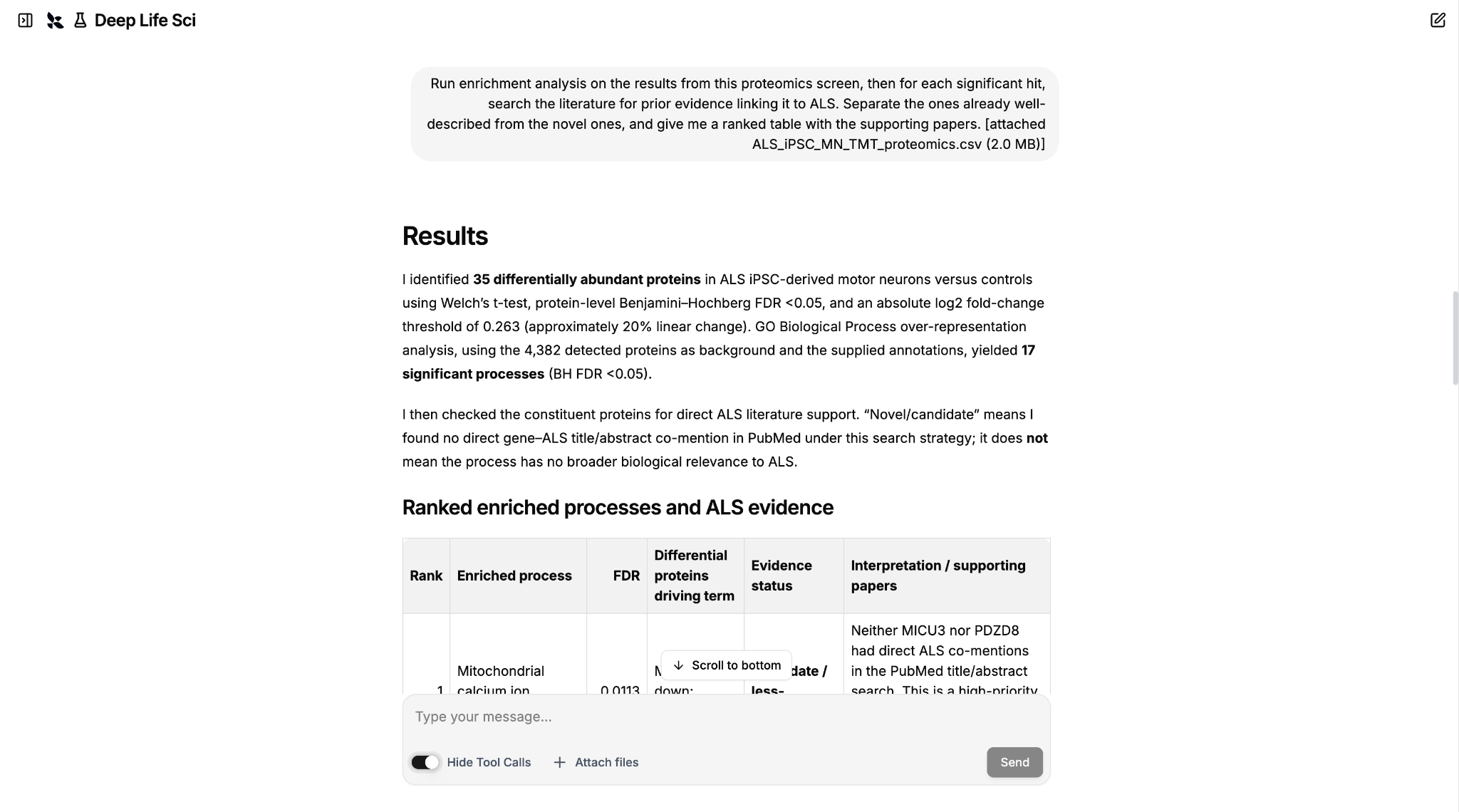
In a typical workflow, a lab scientist finishes an RNA-seq or proteomics screen and uploads the results table. The agent runs enrichment in the sandbox to identify differentially expressed genes, then searches the literature for prior evidence linking each hit to the phenotype, separates well-described genes from novel ones, and returns a ranked table with the supporting papers.
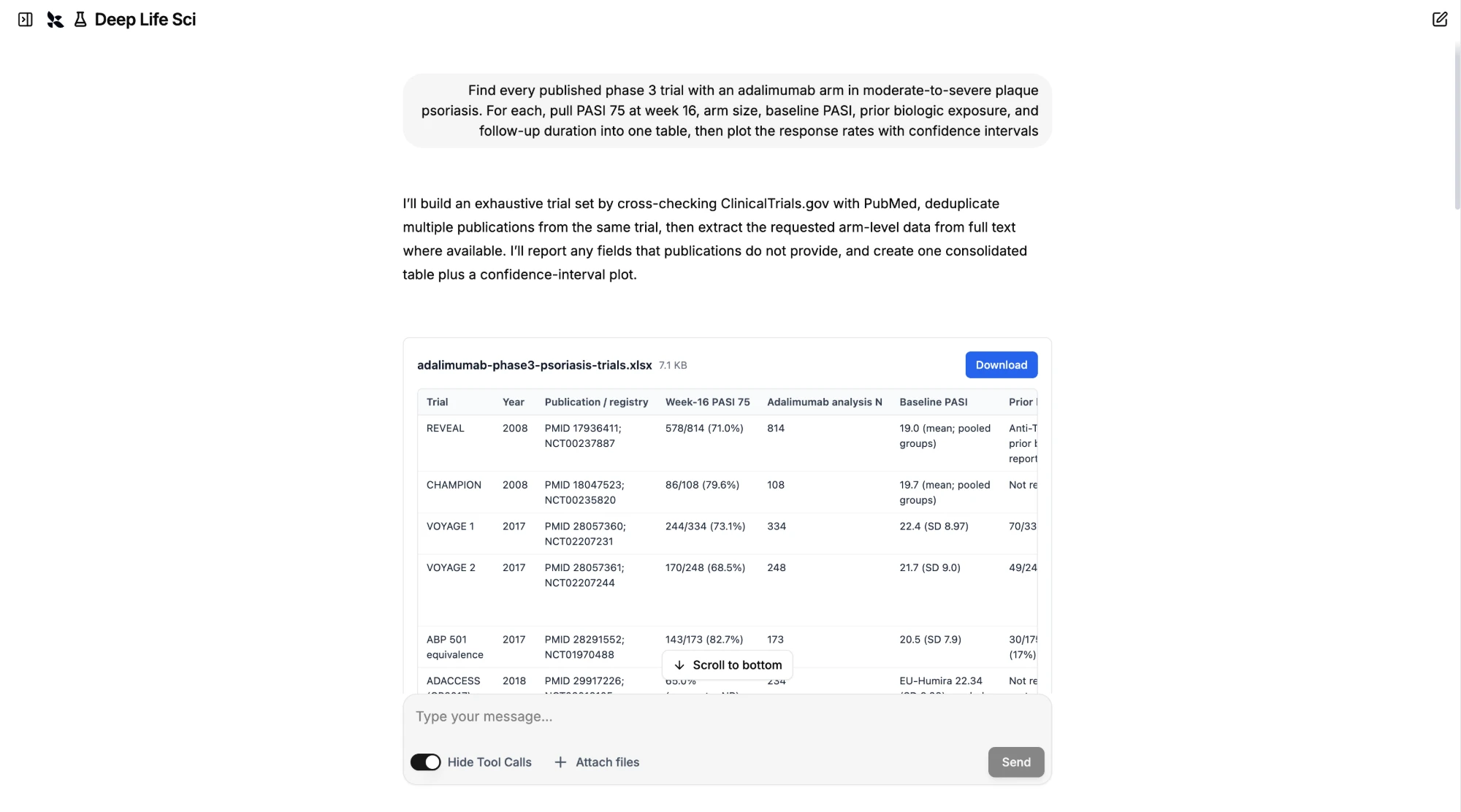
A clinical development or HEOR team, on the other hand, might need to find every published trial of the standard of care in an indication, with the endpoint value, N, population characteristics, and follow-up duration extracted consistently. The agent runs the search, screens against the criteria, extracts each trial into a common schema, and produces both the table and a forest-plot-style comparison.
During the clinical trial phase, thousands of pages of different types of documents are created, ranging from informed consent, clinical protocol documents and amendments, case report forms, and more – all of which must be thoroughly audited, reviewed, and edited numerous times before being finalized. Using Deep Life Sci, users can upload reference protocol documents, research and gather additional statistical information, and quickly curate necessary feedback and edits that could ultimately cut clinical documentation time significantly.
Owning your own intelligence in research and development
The value of Deep Life Sci further compounds when the agent is optimized and integrated into a company’s ecosystem. Deep Life Sci knows what the primary endpoint is, but it doesn’t know company-specific nuances such as results from internal assays, which endpoints regulators pushed back on, or which trial sites actually enrolled rather than just promising to.
Integrating this context into the harness is what owning your intelligence looks like in practice, and because Deep Life Sci’s code is open source, organizations can approach this however they wish. This customization can include adding integrations with internal data and documentation, leveraging different frontier and open source models, enforcing guardrails and approval gates, and more.
Modifying the harness puts you inside the agent development lifecycle (ADLC): build, test, deploy, monitor, then feed what you learned back into the next version. Tracing and evaluations help power this development loop.
Tracing: know what your agents are doing
Every Deep Life Sci run is logged end-to-end in your own LangSmith account, including the literature searches the agent issued, the code it ran in the sandbox, the documents each sub-agent read, and how it moved from those to its answer. These trajectories allow for debugging and improvement of the agent, and serve as an audit record.
Evaluations: continuously improve your agents
Evaluations tell you whether a change to the agent helped its performance. Deep Life Sci ships with a default eval set that can be modified and added to as you add integrations and identify new use cases. Run the set before and after you swap a model or rewrite a prompt, and you'll see whether the new version actually improved or quietly regressed.
Agentic AI is already revolutionizing fields like coding and mathematics. Biomedicine, where cost-effectiveness and iteration speed directly translate into human lives saved, should not be left behind. Biotech and pharma companies that combine open source tools like Deep Life Sci and the ADLC capabilities of LangSmith can reverse Eroom’s law by delivering cost savings and faster iteration across the drug development cycle.
Get started with Deep Life Sci here.